NEAR’s third workshop entitled: ”Methodological issues in harmonizing and pooling of data” was conducted on-site, as well as online with 70 attending participants. It was chaired by Debora Rizzuto.
After a short update and welcome addressed by Laura Fratiglioni, Alexander Darin-Mattsson and Xiaonan Hu presented how to conduct a study within NEAR and demonstrated the NEAR platform.
The invited guests, Scott Hofer, Professor at University of Victoria, and Patrick Curran, Professor at University of North Carolina at Chapel Hill, held two fantastic and inspiring talks on introduction and more advanced methods for pooling and harmonizing data.
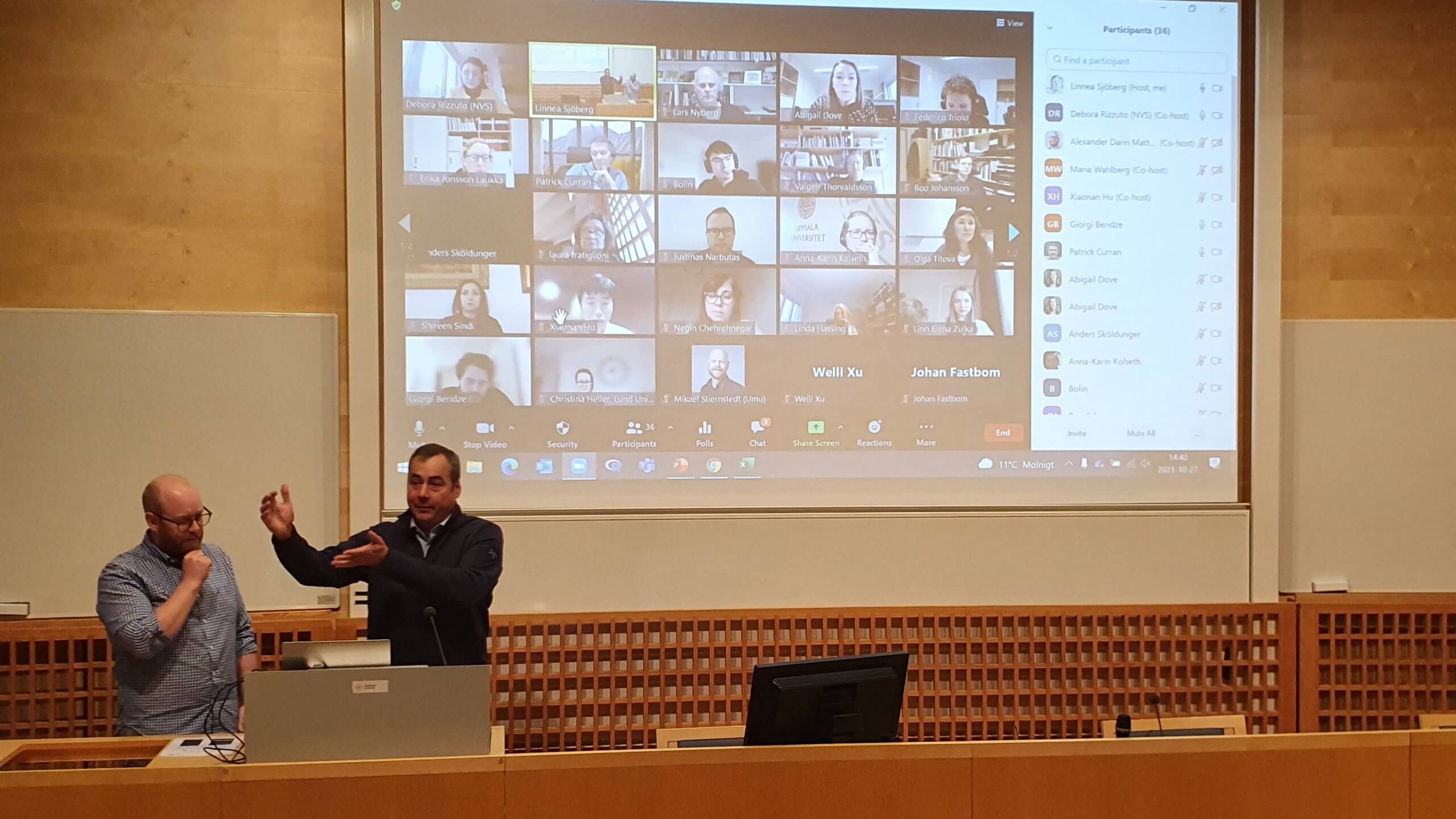
The workshop ended with a group assignment where the participants were divided into smaller groups and had the opportunity to conduct harmonization on NEAR data by using the NEAR platform.
The presentations and group assignments rendered a lot of discussion and positive comments and will likely lead to future collaborations.
Read program here.

NEAR is happy to share that we are expanding to include Uppsala University and two additional databases: the Uppsala Longitudinal Study of Adult Men (ULSAM) and the Healthy Ageing Initiative (HAI). HAI is led by Peter Nordström and Anna Nordström, and ULSAM is also led by Peter Nordström. ULSAM is a population-based longitudinal cohort study […]
As aging is a global phenomenon with challenges that transcend borders, NEAR views building strong international partnerships with similar research networks and studies as essential. Thus, we’re happy to announce our new partnership with the Spanish Seniors-Enrica study. What is Seniors-Enrica? Seniors-Enrica is a national study on nutrition and cardiovascular risk factors, featuring two cohorts: […]
We are excited to share that NordForsk has awarded NEAR 5,515,823 SEK for the NEXT-NORD project: NEXT Generation Transdisciplinary Aging Research for Nordic Excellence, for 2026−2031. Why this matters The Nordic countries are uniquely positioned to lead globally in aging research, thanks to decades of high-quality, population-based studies, which can be linked to registers. However, […]