Celebrating 25 years of SNAC: A quarter of a century of research on ageing
2026-11-27
On November 20, 2026, study participants, researchers, healthcare professionals and societal stakeholders gathered at Aula Medica, Karolinska Institutet (KI), to celebrate the 25th anniversary of the Swedish National Study on Aging and Care (SNAC). The event, which was also part of NEAR’s scientific workshop activities, provided an opportunity to look back on
25 years of ageing research and discuss how the knowledge generated through SNAC can contribute to better health, care and quality of life for older people.
Since its establishment in 2001, SNAC has collected extensive longitudinal data on health, functioning, living conditions and care needs among older people in Sweden. The four SNAC population-based studies in Kungsholmen, Blekinge, Skåne and Nordanstig are part of the National E-infrastructure for Aging Research (NEAR).
The day opened with welcome addresses from Robert Mjörnberg, Vice Mayor for Elderly Care in Stockholm, and Maria Eriksdotter, Advisor to the KI President on collaboration with health care. Laura Fratiglioni, one of the founders of SNAC-K, then moderated a session with fellow members of the SNAC founding team Sölve Elmståhl, Johan B Sanmartin, Anders Wimo and Mårten Lagergren. Together, they reflected on the origins of SNAC, its development over the past 25 years and its contribution to ageing research in Sweden.
The following session, chaired by NEAR Director Debora Rizzuto, focused on joint research findings from the SNAC sites. Amaia Calderón-Larrañaga, Principal Investigator of SNAC-K, discussed how monitoring the health of older people can support the development of proactive and integrated care, followed by Anders Wimo, who presented research on the prevalence and societal costs of dementia in Sweden.
The morning continued with a panel discussion moderated by Åsa Hedberg Rundgren, Director of the Stockholm Gerontology Research Center,on the use of SNAC data in policy and practice. Representatives from Region Skåne, the National Board of Health and Welfare, the City of Stockholm and the SNAC studies discussed how research findings can inform healthcare and social care planning.
A special moment of the morning was the award ceremony recognising two outstanding doctoral theses based on SNAC data.
The afternoon session, chaired by Maria Eriksdotter, showcased scientific findings from the different SNAC sites. Bettina Meinow and Åsa von Berens presented research on the needs, living conditions and support of older people receiving eldercare. Giulia Grande discussed the potential of blood-based biomarkers for the early detection of dementia, while Johan B Sanmartin addressed oral health as an often overlooked aspect of ageing.
The session continued with Marie Bjuhr, who presented research on extended working life and remaining active in older age, followed by Sölve Elmståhl, who addressed loneliness, social isolation and the experiences of relatives of older people.
The scientific programme concluded with a panel discussion moderated by Wilhelmina Hoffman
, President of the Swedish Dementia Centre, bringing together study participants, researchers and representatives from research infrastructures and healthcare to discuss how research can better respond to the needs of older people.
The SNAC anniversary was an important opportunity to recognise the value of long-term investments in population-based studies. Through NEAR, researchers can access data from the SNAC cohorts and combine them with data from other longitudinal studies across Sweden, creating further opportunities for national and international collaborative research.
A special thank you goes to all SNAC study participants who have generously contributed their time and effort over the past 25 years, making this research possible.
Congratulations to the entire SNAC community on 25 years of research, and many thanks to all the organisers, speakers, chairs and participants who made this anniversary a memorable event!
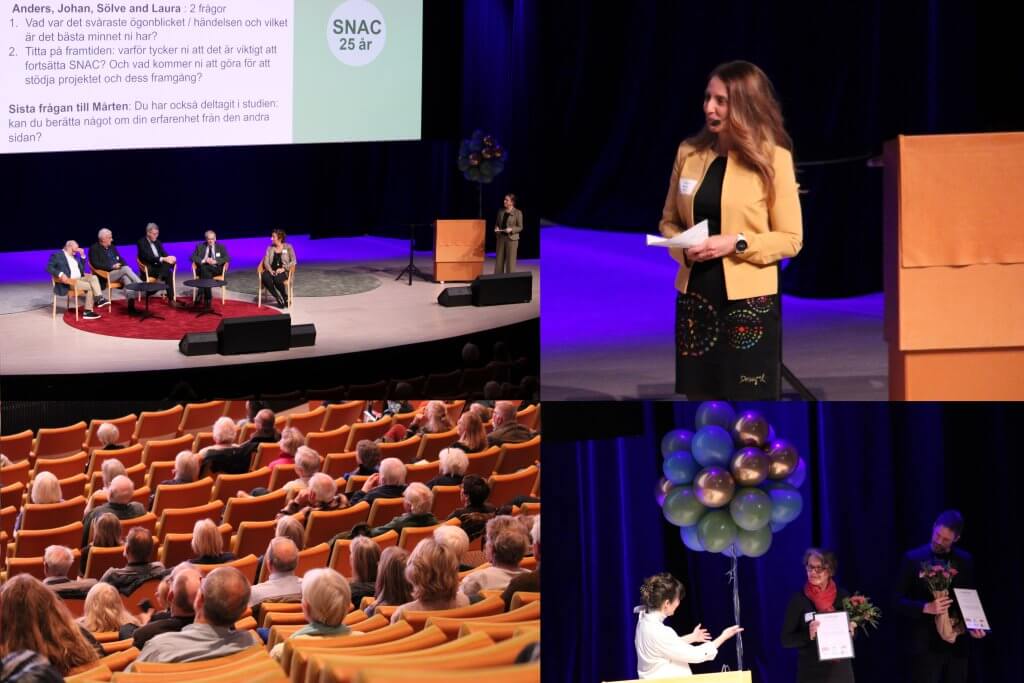
Photo: Maria Yohuang